FIELD GUIDE · BOOK CLUB
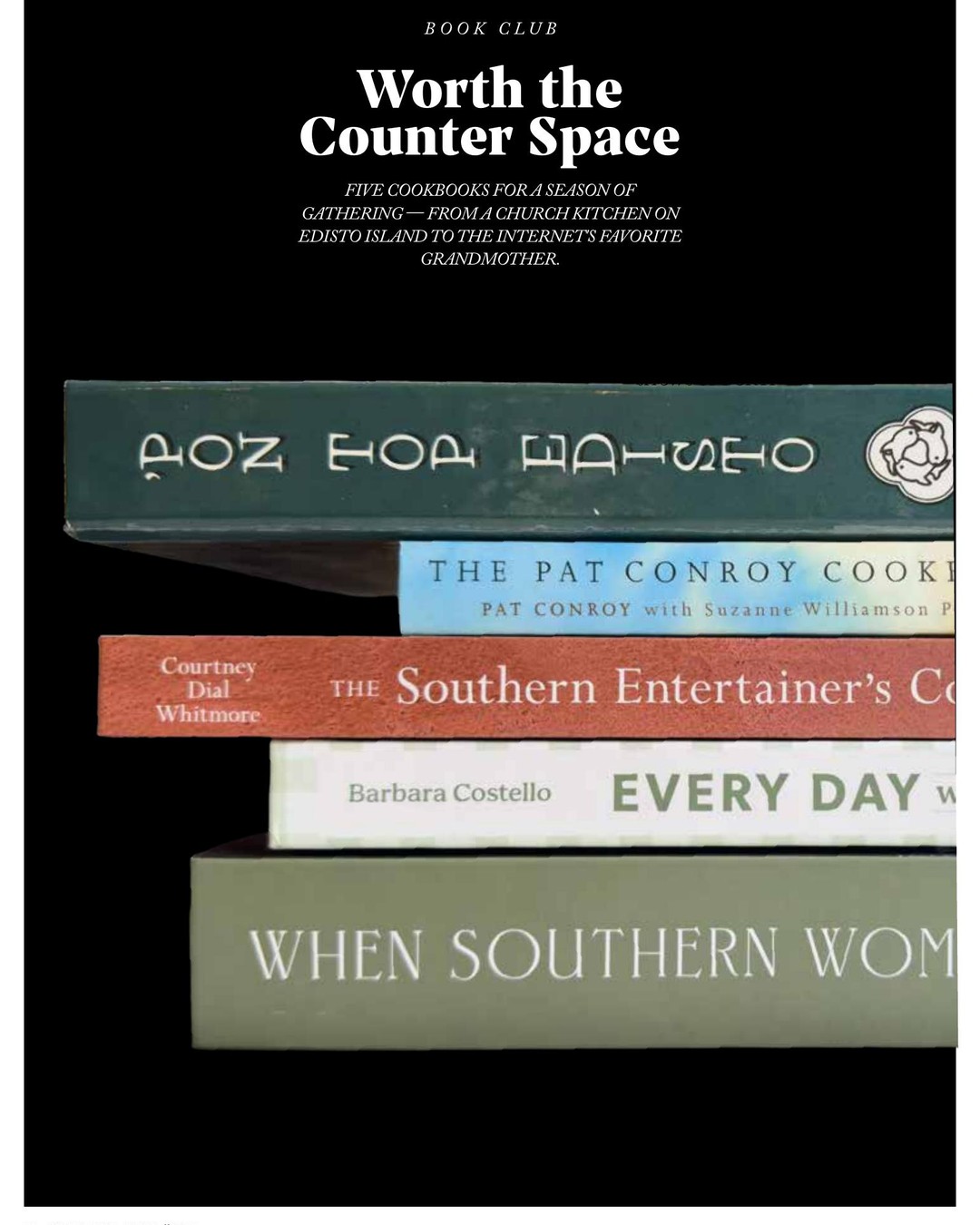
Five cookbooks for a season of gathering, from a church kitchen on Edisto Island to the internet’s favorite grandmother.
words by Jenna Lachenman
Every recipe worth keeping is really two things: a dish you want to savor and a story you want to remember. Your grandmother’s handwriting on the index card, the church supper where somebody finally gave up their secret ingredient, the busy Tuesday night rescued by a sheet pan that enticed everyone to finally take a pause, together.
Fall is when we come back to the table. These five books earn their counter space this season not because every recipe is a showstopper, but because each one understands what a table is for. Two are Lowcountry to the bone. One belongs in every host’s kitchen. One will get you through the week. And one is the argument, 520 pages long, that Southern cooking has always been the true storyteller of the South.
’Pon Top Edisto: Cookin’ ’Tweenst the Rivers
Start closest to home, with the oldest kind of cookbook there is. Long before anyone had a book deal, Southern women were compiling: the church cookbook, the Junior League cookbook, the spiral-bound fundraiser with the plastic comb that eventually loses a tooth or two. Every parish in the Lowcountry has produced at least one, and they all work the same way. Somebody types up the recipes, somebody’s daughter draws the cover, and every dish goes into print with a name beneath it, so that forty years later a stranger can still tell whose oyster stew it was.
’Pon Top Edisto is one of the good ones. Put together in 1998 by the members and friends of Trinity Episcopal Church on Edisto Island, a parish that dates to the 1770s, on an island that sits, as the subtitle says, between the North and South Edisto rivers. It is 287 pages of exactly what it promises. The title is Gullah for “on Edisto,” and the book opens with the whole island in a sentence: “Only a lazy man could go hungry on Edisto.” What follows is the proof. A dozen plantation recipes with the house names still attached, Seabrook House Oyster Stew, Cypress Trees Shrimp Paste, Cassina Point French Toast, and a regional Tabasco Community Cookbook Award to show that somebody beyond the island noticed. But the real pleasure is the names under the recipes, and the notes in the margins explaining that this one has been “altered, adapted, adopted and enjoyed” by whoever contributed it. Nobody in this book set out to be an author. They set out to feed a Sunday, and somebody had the sense to write it down. Look for it at the Edisto Island Museum gift shop, and drive it home the long way.
The Pat Conroy Cookbook: Recipes and Stories of My Life
Pat Conroy grew up down the coast from that island, and he understood better than anyone that a Lowcountry meal is mostly the story told over it. The Pat Conroy Cookbook begins with the line that might as well be this page’s thesis, “A recipe is a story that ends with a good meal,” and then delivers twenty-two chapters of exactly that, a memoir wearing a cookbook’s apron. Conroy wrote it with Suzanne Williamson Pollak, the friend who taught him to cook after his novels had made him famous, and the hundred or so recipes are hung on the stories rather than the other way around. His mother’s kitchen is here. Beaufort in shrimp season is here. So is the fighter-pilot father who became The Great Santini, and a honeymoon spent wandering the markets of Umbria, and a table in New Orleans the night The Prince of Tides came out. Breakfast shrimp and grits, sweet potato rolls, and a whole chapter’s worth of the long, loud, overfed suppers his novels turned into literature. The recipes work. The stories are what you’ll read aloud to whoever is chopping onions beside you. Keep it on the nightstand as much as the counter.
The Southern Entertainer’s Cookbook: Heirloom Recipes for Modern Gatherings
That is the pair that is Lowcountry to the bone. The next one is for what to do this Saturday. The Southern Entertainer’s Cookbook comes from Courtney Dial Whitmore, the Nashville stylist behind the party blog Pizzazzerie, who wrote it with her mother, Phronsie Dial. Whitmore went back into the family’s recipe boxes and did the work every host wishes someone would do for her: she made each dish ready for company, with no hard-to-find ingredients and no grandmother-only techniques. Nashville hot chicken biscuits as a passed appetizer. Phronsie’s banana muffins. A caramel celebration cake, a peach lattice cobbler, watermelon mint juleps, and a Lowcountry shrimp and grits that will make you feel briefly, pleasantly homesick for your own kitchen. The book is organized the way a host actually thinks, appetizers through desserts with drinks in between, and the styling tips are the kind you’ll use. If you’re the one in your circle who says “come over” first, this is your book.
Every Day with Babs: 101 Family-Friendly Dinners for Every Day of the Week
And because gathering isn’t only the big nights, that rescued Tuesday counts, Every Day with Babs makes the case for the weeknight table. Barbara Costello was a retired teacher in Connecticut, mother of four and grandmother to a houseful, when her daughter talked her into making a cooking video in the first weeks of the pandemic. Five years later she is “Brunch with Babs” to several million people, and she got there by doing on camera what she’d done for decades at home: getting dinner on the table and everyone around it. The house rule that hangs in her kitchen is the one to steal, “Treat family like company and company like family,” and her second cookbook is built on the week itself: sheet pans on Monday, batch cooking Tuesday, one pot Wednesday, the slow cooker on Saturday, something worth dressing for on Sunday. No fuss, no ego, and a quiet insistence that a weeknight table is still a table. Most of the moments we’ll remember from this fall will not be the parties.
When Southern Women Cook: History, Lore, and 300 Recipes with Contributions from 70 Women Writers
Save the biggest for last. When Southern Women Cook is America’s Test Kitchen’s first Southern cookbook, edited by Cook’s Country’s Morgan Bolling with a foreword by Toni Tipton-Martin, and it is the book on this list most likely to change how you see the plate in front of you. Three hundred test-kitchen recipes, Gullah Geechee rice, Brunswick stew, a pickle-brined fried chicken sandwich, Dollywood’s cinnamon bread, a Viet-Cajun shrimp boil, are braided with essays from seventy women: historians, journalists, and a beverage historian. It begins with the enslaved cooks at Monticello and ends somewhere near your own kitchen, and its argument is simple and overdue: if Southern cooking is the storyteller of the South, the women who did the cooking have been telling the story all along. Somewhere in the middle of it, the Georgia cook Virginia Willis explains biscuits in a sentence that turns out to be about everything else, too: “Biscuits are like people; they are better when they rise together.”
None of these books is really about dinner. They are about who was at the table, and what was said there, and the fact that somebody thought the story worth remembering. Cook from them this fall. Then write in the margins. That is how the next one gets made.
The Stack
- ’Pon Top Edisto · Trinity Episcopal Church, Edisto Island · $19.95, Edisto Island Museum
- The Pat Conroy Cookbook · Nan A. Talese · $25
- The Southern Entertainer’s Cookbook · Courtney Dial Whitmore · Gibbs Smith · $32
- Every Day with Babs · Barbara Costello · Clarkson Potter · $35
- When Southern Women Cook · America’s Test Kitchen · $40