ARTS & CULTURE
Middleton Place’s “Conversations of Freedom” exhibit tells the Revolutionary story through the people who lived it—signers and enslaved alike.
words by Jenna Lachenman · images by Palm Social
This year, Charleston joins Boston, Philadelphia, New York and Washington, D.C., as one of only five Signature Cities chosen to mark the 250th anniversary of the American Revolution. Middleton Place—home to a signer of the Declaration and a National Historic Landmark—is among the heritage sites at the center of that commemoration.
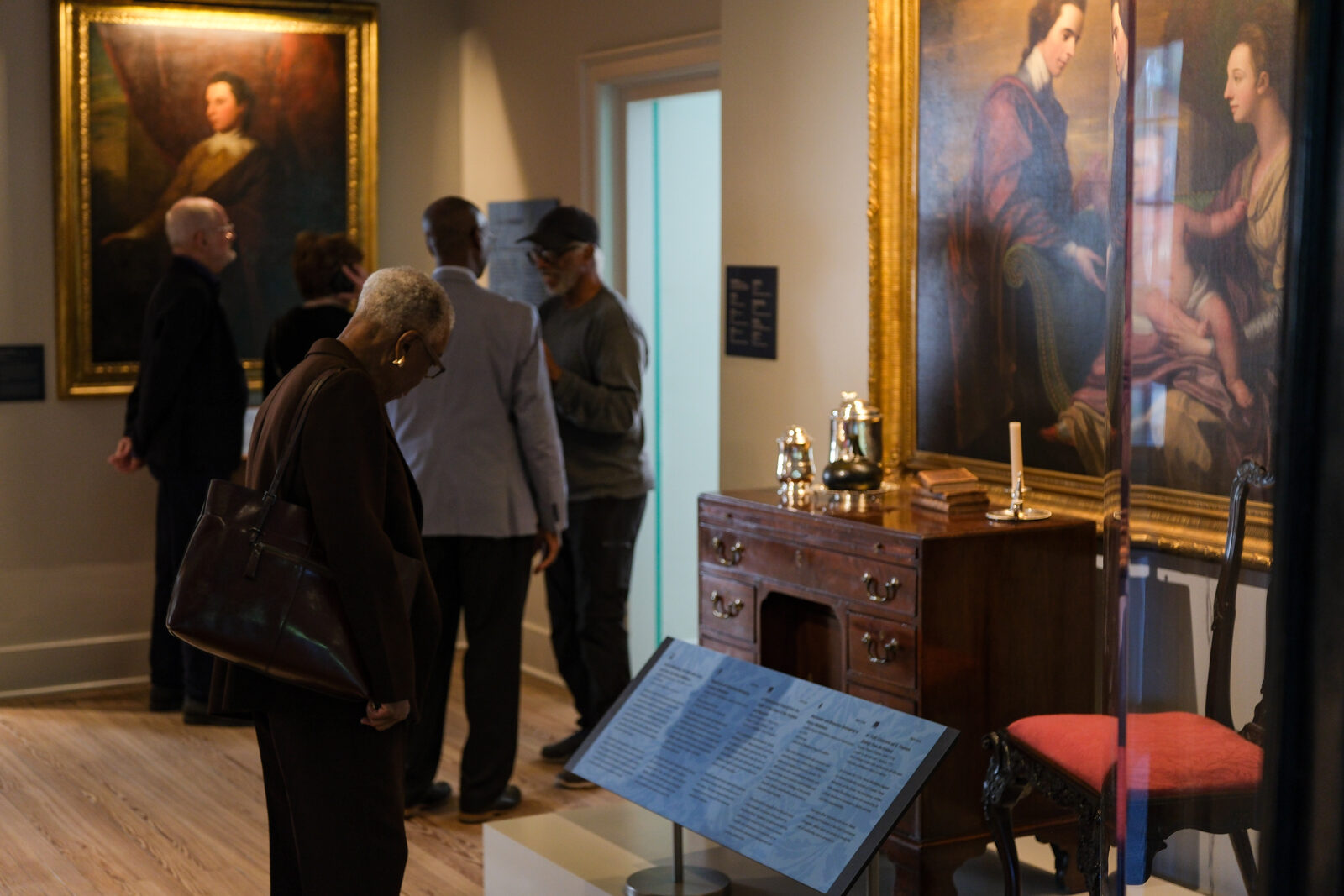
There is a silk copy of the Declaration of Independence inside the South Flanker House at Middleton Place. It is one of only four known to exist, and it hangs in a room where the light is kept low and the air holds still, the way air does in places that understand what they’re protecting. The document is beautiful and rare, but it is not the heart of the exhibit. The people are.
“Conversations of Freedom: The American Revolution at Middleton Place,” which opened in April and runs through December 2029, traces the Revolutionary period from 1770 to 1783 through the intertwined lives of those who shaped this particular corner of the Lowcountry—and those who were shaped by it. Arthur Middleton signed the Declaration. His wife, Mary Izard Middleton, kept the household and the legacy intact while war pressed in from every side. Her miniature portrait on ivory, one of the exhibit’s most intimate artifacts, renders a woman whose composure tells its own kind of story.
But the exhibit’s most powerful thread belongs to those whose names were not affixed to any founding document. Lucy Banbury, enslaved at Middleton Place, escaped in 1777 and found passage with the British. She eventually sailed to Sierra Leone in 1791, building a free life an ocean away from the plantation that had claimed her labor. In one of the exhibit’s most affecting moments, a projection brings Lucy and John—a member of the Middleton household—into the same frame, their stories converging and diverging in ways that resist simple interpretation.
Robert Bellinger, a descendant of Middleton Place’s enslaved community, provides the exhibit’s closing audio reflection—a voice that carries forward what the artifacts cannot. It is a deliberate choice, and a meaningful one: the last word belongs to the lineage that lived this history most fully.
Middleton Place is one of only a handful of remaining American sites associated with a signer of the Declaration (Hopsewee Plantation on the Santee, birthplace of fellow signer Thomas Lynch Jr., is another), and the property has long been a destination for those drawn to the Lowcountry’s layered past. “Conversations of Freedom” deepens that experience by refusing to flatten history into a single narrative. Revolution, the exhibit reminds us, looked different depending on where you stood—and whether you were free to stand there at all.
The exhibit is now included with general admission to Middleton Place and is part of the Museums For All initiative, ensuring accessibility regardless of income. It is a space worth entering slowly, and worth sitting with afterward—one of those rare museum experiences that asks you not just to look, but to listen.
If You Go
Conversations of Freedom: The American Revolution at Middleton Place
South Flanker House Museum, Middleton Place
4300 Ashley River Road, Charleston, SC 29414
On view through December 2029 · Included with general admission ($35) · middletonplace.org